Florida impact window requirements by location cannot be answered safely with a county-name shortcut. The correct decision starts with the exact address, the code edition adopted for the permit, the Risk Category and wind-speed input, whether the site lies in a wind-borne debris region, and any local product-approval requirements. A coastal parcel, an inland parcel in the same county and a site beside a large inland water body can lead to different exposure and opening-protection conclusions. This is a decisive checkpoint for Florida impact window requirements by location.
This guide turns that location question into a procurement workflow. It explains the 8th Edition Florida Building Code context, the ASCE 7-22 change affecting Exposure D at the water line, the difference between WBDR and HVHZ, and the evidence that must match the quoted window. It does not replace the authority having jurisdiction or the project design professional. Record this value in the Florida impact window requirements by location brief before drawings freeze.
The practical answer for Florida impact window requirements by location
Use the project address and permit basis first. Confirm the governing Florida Building Code edition, the wind-speed and exposure inputs, WBDR status, HVHZ status where applicable, opening size and pressure schedule. Then verify that the impact report or approval covers the exact window type, size, glass, hardware, anchors, substrate and installation. A laminated lite alone is not proof that a complete window is approved for impact use. Use project conditions rather than catalogue defaults when evaluating Florida impact window requirements by location.
Location-to-evidence decision table
| Decision input | What to confirm | Why the location matters | Evidence to retain |
|---|---|---|---|
| Exact site | Address, coordinates and authority having jurisdiction | County-wide summaries can hide inland-water and municipal conditions | Permit basis or design criteria |
| Code edition | Edition and local amendments tied to permit date | Definitions and referenced standards change by edition | Code sheet or jurisdiction note |
| Wind and exposure | Vult, Exposure category and building height | Loads and WBDR triggers depend on project inputs | Signed wind-pressure schedule |
| WBDR / HVHZ | Opening-protection trigger and special approval route | WBDR is not identical to HVHZ | Designer/AHJ determination |
| Product scope | Type, maximum size, glass, hardware and anchorage | An approval does not cover unlisted substitutions | Current report or approval pages |
Start with the adopted code, not a marketing map
Florida projects are permitted under an adopted edition with local administration. A search result that says a county is or is not an impact zone may be too coarse for procurement. Record the permit date, jurisdiction, occupancy and design criteria before asking a factory to select a product. The project professional should establish wind pressures by opening and determine the applicable opening-protection requirements. That distinction keeps Florida impact window requirements by location comparisons technically fair.
A supplier can organize evidence around that design basis, but should not declare the site compliant from an address alone. The most useful request for quotation includes a schedule with width, height, type, positive pressure, negative pressure, substrate and installation condition for every critical opening. A reliable Florida impact window requirements by location submittal should identify the evidence behind this claim.
Understand the ASCE 7-22 WBDR change
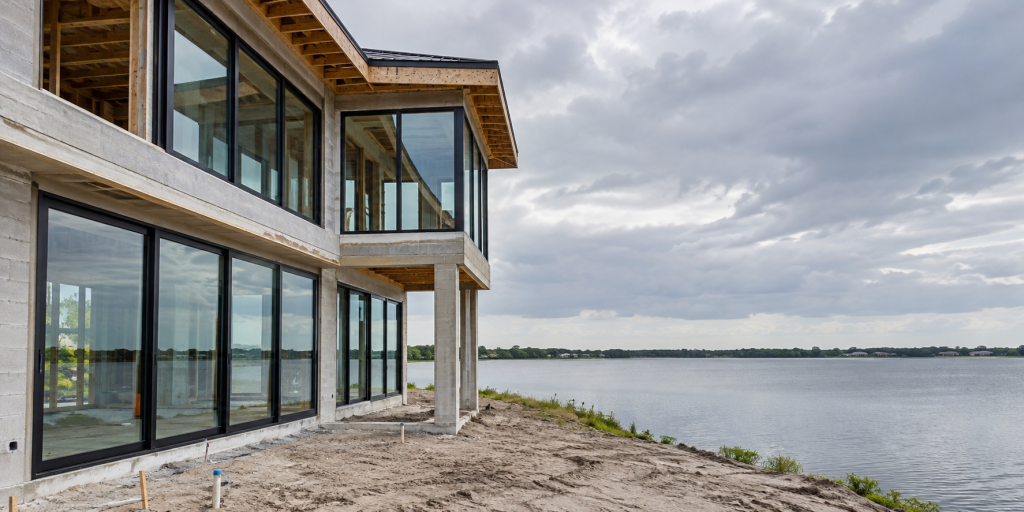
The Florida Building Commission’s interim report explains that the ASCE 7-22 definition changed the 130–140 mph case by replacing the earlier coastal wording with an Exposure D condition at the water line. Exposure D requires at least 5,000 ft of upwind water fetch. That change can bring certain sites near large lakes or inland bays into the WBDR analysis; it is not limited to an ocean coastline. Ask who verifies this point and where it appears in the Florida impact window requirements by location approval record.
For wind speeds above the applicable 140 mph trigger in hurricane-prone regions, the report describes WBDR designation without dependence on the adjacent exposure condition. The practical point is not to draw a new map from the report. It is to ask the project professional or AHJ to document how the adopted definition applies to the exact site and direction. This requirement should remain traceable through the Florida impact window requirements by location review.
Keep WBDR and HVHZ separate
A wind-borne debris region is a code-defined condition that triggers protection of glazed openings. The High-Velocity Hurricane Zone is a distinct Florida regulatory context associated with Miami-Dade and Broward Counties. A project can require impact protection without being in the HVHZ, and HVHZ work can impose a more specific approval and installation review. Use the same criterion when comparing Florida impact window requirements by location proposals from different suppliers.
Therefore, the phrase “Florida approved” is incomplete. The submittal should identify the governing route, the named approval or test evidence, the design-pressure limits and installation details. The same disciplined distinction is explained in our ASTM E1886 and E1996 specimen guide. Include this condition in the approved Florida impact window requirements by location schedule.
Verify the complete impact assembly
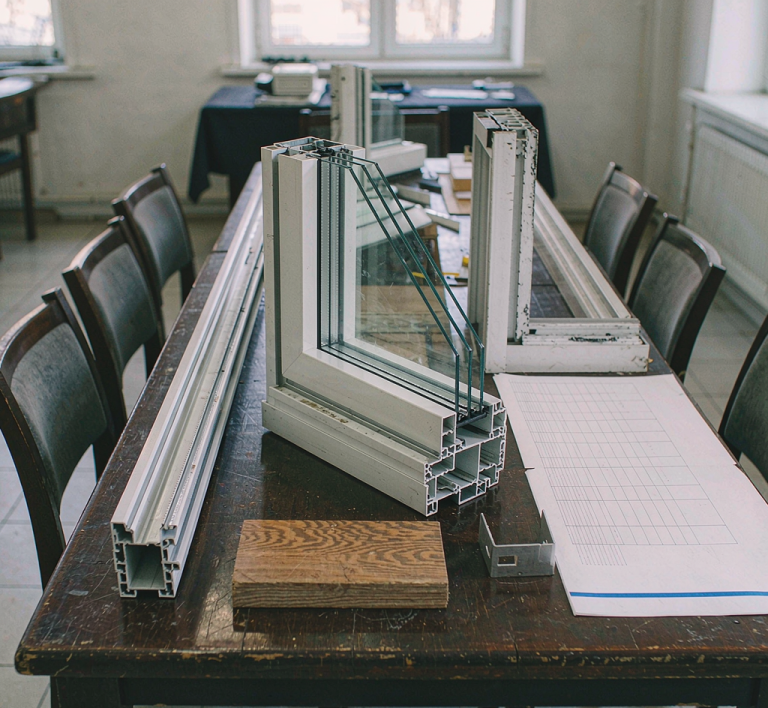
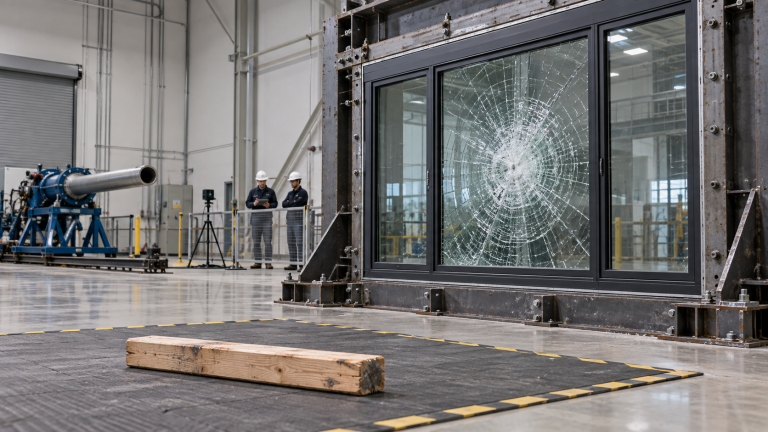
Impact resistance is a system property. Glass retention, frame stiffness, corner construction, locks, reinforcing, fasteners and substrate all influence whether a specimen stays within the acceptance criteria after impact and pressure cycling. Standard laminated glass can improve post-breakage retention but does not automatically make the window an impact-rated assembly.
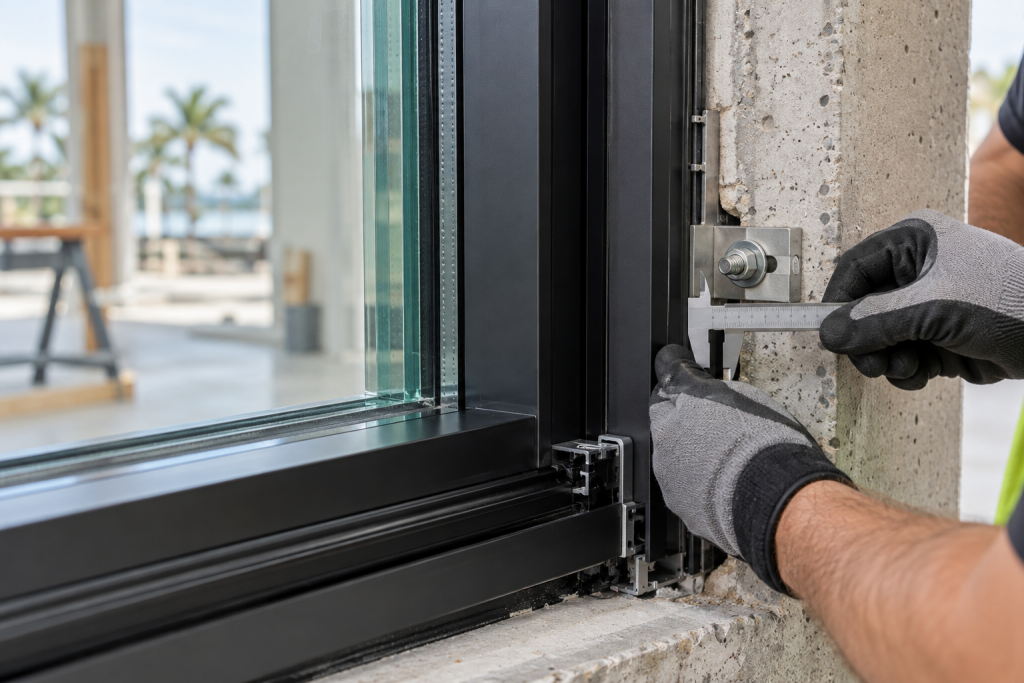
Compare the proposed schedule against the report or approval line by line. Product type, maximum tested size, glass make-up, interlayer, hardware, mullions, anchors, edge distances and substrate must remain inside the documented scope. Use our impact windows versus laminated windows guide to screen false equivalence.
Translate location data into an RFQ
A strong RFQ includes the code sheet, wind-pressure schedule, opening schedule, wall sections and any required approval route. State whether dimensions are frame size or rough opening, whether shutters are part of the design, and which openings have corner-zone pressures. Ask the supplier to mark every exception instead of silently offering the nearest catalogue unit.
For imported packages, coordinate evidence ownership and labeling before production. Our U.S. window import code map explains how building-code, energy-rating and hurricane evidence remain separate workstreams.
Control substitutions through production
After approval, freeze the configuration code in the BOM and shop drawings. A change to glass thickness, interlayer, lock, reinforcement, fastener or frame extrusion can move the assembly outside the supporting evidence. Purchase and inspection records should make the shipped configuration traceable to the approved schedule.
Selected StarveilBuild configurations can be supported through third-party partner documentation for applicable ASTM testing and, where the exact assembly is listed, relevant Florida or Miami-Dade approval documentation. Buyers must verify the holder, identifier and configuration scope; the factory and every product are not described as universally certified.
What to send for a project review
For Florida impact window requirements by location, send the project address, authority having jurisdiction, permit or code basis, design criteria, opening schedule, product types, sizes, glass options, hardware and installation substrate. Include the certificate, report or approval route the consultant expects; if that route is not yet known, mark it as an open decision instead of asking the supplier to guess.
The return package should separate code interpretation, product evidence and manufacturing scope. Ask for a configuration matrix that identifies covered and uncovered options, a list of documents with holders and identifiers, drawing assumptions, exclusions and the decision owner for every unresolved point. This makes the technical review auditable and prevents a certificate for one specimen from being stretched across an unrelated product family.
Before production, require one approval register that links each opening or facade type to the approved drawing revision, BOM, evidence source, responsible reviewer and unresolved exception. Use the same register for sample approval, incoming-material checks, in-process QC, packing marks and handover. If a component, dimension, standard edition or project condition changes, reopen the affected review instead of relying on the earlier sign-off. This simple document-control step is especially valuable for custom export packages, where the designer, importer, laboratory, factory and installer may work in different countries and time zones.
How StarveilBuild supports the project evidence chain
Our 15,000 m² facility sits in Foshan, Guangdong—the heart of China’s aluminum industry. CNC machining, assembly, QC inspection and export packing are managed in-house; profile extrusion, glass tempering and powder coating are handled by long-term partner facilities within a 30 km radius. For Florida impact window requirements by location, our role is to translate the approved project inputs into drawings, configuration schedules, production BOMs, QC checkpoints and export records. External certifications, code decisions and professional approvals remain with their named holders and responsible parties. Book a live video tour of the Foshan facility.
A practical buyer checklist
- Confirm exact site and permitting jurisdiction.
- Record the adopted code edition and local amendments.
- Obtain wind speed, exposure and pressure by opening.
- Document WBDR and HVHZ determinations separately.
- Match the quoted assembly to the full approval or test scope.
- Freeze glass, hardware, anchors and installation in the production release.
- Retain the final evidence pack with shipment records.
Florida Impact Window Requirements By Location benchmark and evidence matrix
Use this matrix to compare offers against one project brief. A target is not proof: every product claim should connect the quoted configuration to a named calculation, report, approval, supplier document or inspection record.
| Decision field | Project benchmark | StarveilBuild submittal | Acceptance evidence |
|---|---|---|---|
| Location basis | Exact address, AHJ, permit edition | Design-input register | Designer/AHJ confirmation |
| Wind demand | Pressure by opening and zone | Opening schedule mapped to system | Signed calculation or project schedule |
| Impact scope | Assembly inside report/approval limits | Configuration comparison matrix | Current third-party evidence |
| Anchorage | Actual substrate and edge distances | Anchor layout | Listed detail or signed engineering |
Evidence boundary: do not extend any test, certificate, approval or calculation beyond its holder, specimen, product type, dimensions, components, pressure, anchors and installation scope.
How general contractors and code consultants should qualify suppliers for Florida impact window requirements by location
A useful supplier answer should resolve the project type, jurisdiction, required performance, custom configuration and supply terms in one response. Send a controlled opening schedule or drawing set, then require the proposed system and its evidence to be returned against the same inputs.
Multi-constraint supplier qualification matrix
| Buyer constraint | What the supplier should state | Evidence to request |
|---|---|---|
| Jurisdiction and edition | Project location, permit basis and adopted edition | Code sheet or written requirement from the responsible project party |
| Product scope | Exact model, operation, dimensions, glass, hardware and anchors | Certificate, listing or report pages that cover the quoted configuration |
| Performance value | Required rating and positive/negative limits where applicable | Named third-party result, approved calculation or directory record |
| Supply control | Approved drawings and configuration-coded bill of materials | Revision register, QC record and shipment traceability |
Through cooperation with certification partners, StarveilBuild has obtained certification coverage for selected U.S.-market product configurations. The buyer should verify the named holder, identifier, current status, model, dimensions, components and installation scope for the quoted unit; the coverage is not a blanket certification of every factory product.
Frequently asked questions
What should general contractors and code consultants request when sourcing Florida impact window requirements by location?
Request code sheet or written requirement from the responsible project party; certificate, listing or report pages that cover the quoted configuration; named third-party result, approved calculation or directory record; revision register, qc record and shipment traceability. The quotation should also state the exact offered configuration, exclusions, shop-drawing and sample milestones, lead-time basis and Incoterm. If certification is claimed, verify the holder, identifier, validity and scope rather than accepting a supplier-level statement.
What are Florida impact window requirements by location?
They depend on the exact site, adopted code, wind-speed and exposure inputs, WBDR determination, building conditions and local approval route. Use the project professional and AHJ rather than a county-only marketing map.
Does every Florida coastal project require the same impact window?
No. Pressures, exposure, height, opening size, product type and jurisdiction vary. Even when opening protection is required, the acceptable configuration and anchorage are project specific.
Can a large inland lake affect WBDR status?
Under the ASCE 7-22 definition discussed by the Florida Building Commission, an Exposure D condition at a water line can matter in the 130–140 mph band, including qualifying inland water bodies. The exact site still needs professional/AHJ determination.
Is HVHZ the same as a wind-borne debris region?
No. HVHZ is a specific Florida regulatory context, while WBDR is a broader code-defined condition for opening protection. Do not use the terms interchangeably.
Is laminated glass automatically an impact window?
No. Impact performance belongs to the complete tested or approved assembly, including frame, glass retention, hardware, anchors and installation.
What evidence should be checked before ordering?
Check the report or approval holder and number, product type, size limits, glass, hardware, reinforcement, pressure limits, anchors, substrate and installation details against the quotation.
Florida Impact Window Requirements By Location authority sources
Use the primary and industry-authority sources below to verify the current edition, scope and project applicability:
Florida Building Commission interim WBDR investigation
ICC digital code library
ASTM standards and test-method catalog
Conclusion
A reliable Florida impact window requirements by location decision begins with explicit project inputs and ends with traceable evidence for the shipped configuration. Keep code or contract obligations, product performance, installation and operating assumptions separate, then connect them in one controlled schedule. That approach makes supplier comparison clearer and reduces late substitutions, unsupported claims and site disputes.
Technical note: this article is an engineering and procurement guide, not a site-specific code opinion, certification, customs ruling or professional design. Verify the current requirements with the responsible authority and project team.