Impact windows vs laminated windows is not a comparison between two equivalent products. Laminated glass describes panes bonded by an interlayer that can retain fragments after breakage. An impact-rated window is a complete, documented assembly—glass, gaskets, glazing bite, sash, frame, hardware, anchors and installation—that has been evaluated against a defined impact-and-pressure protocol. That difference is decisive for hurricane projects because a pane may remain together while the sash opens, the bead releases or the outer frame pulls away from the wall. This is a decisive checkpoint for impact windows vs laminated windows.
The short answer on impact windows vs laminated windows
Specify ordinary laminated glass when the project needs safety glazing, fragment retention, security delay or acoustic damping and no hurricane-impact rating is required. Specify an impact-rated assembly when the governing code, windborne-debris region or project brief requires evidence for missile impact followed by cyclic pressure. In the impact windows vs laminated windows decision, the report must match the exact product type, specimen size, glass make-up, hardware and anchor arrangement proposed for the project.
Impact windows vs laminated windows starts with the claim
A reliable specification begins by naming the performance claim. “Laminated” identifies a glass construction. “Impact resistant” should identify a standard, impact category, design pressure, product type and evidence document. ASTM E1886 provides a test method in which the specimen is impacted and then exposed to specified cycles of positive and negative pressure. ASTM E1996 establishes windborne-debris performance requirements and impact levels for hurricane applications. The authority having jurisdiction chooses the applicable criteria.
This is why a quotation should never convert “we use laminated glass” into “the window is hurricane rated.” The first statement may be verifiable from a glass certificate. The second needs assembly-level evidence. A useful impact windows vs laminated windows submittal separates material data, system test data and project engineering instead of combining them in one brochure sentence.
System-level comparison for project teams
| Decision point | Standard laminated window | Impact-rated window assembly |
|---|---|---|
| Primary evidence | Glass make-up and safety-glazing compliance | Named assembly test, approval or engineering path |
| Impact event | Not necessarily tested as a complete window | Specified missile impact on the assembly |
| Post-impact loading | Not implied by the glass description | Cyclic positive and negative pressure where required |
| Frame and sash | Conventional profile may be used | Configuration is part of the documented specimen |
| Anchorage | Designed for ordinary project actions | Must reproduce or be justified against the approved load path |
| Permitted changes | Project engineer reviews glass substitutions | Size, glass, hardware and anchors stay within evidence scope |
Missile impact is only the first gate
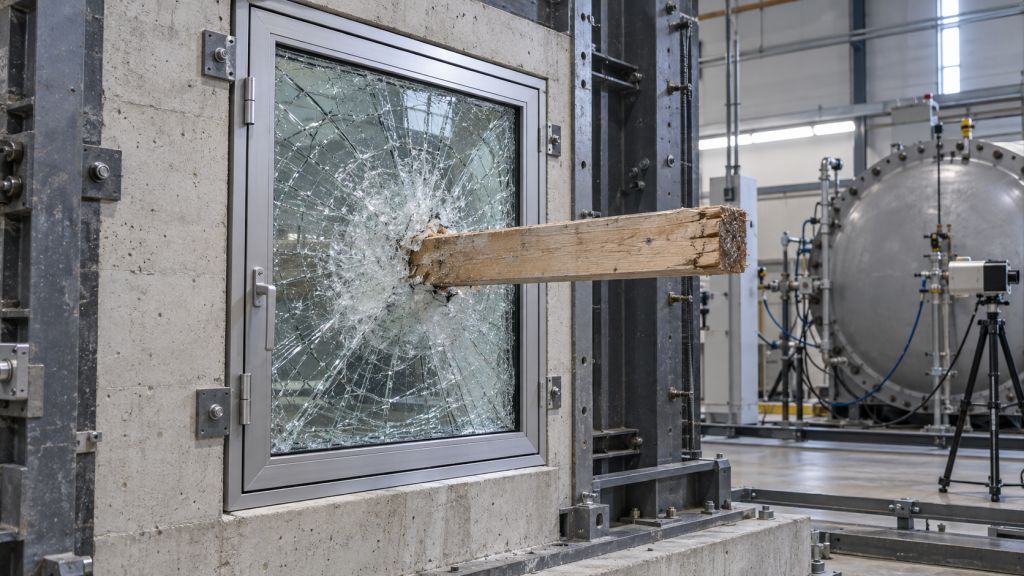
Photographs of cracked glass can make the test look like a glass-only event. It is not. The missile strikes the glazing or another prescribed location, but the energy travels into the edge support, sash corners, hinges or rollers, locks, frame and anchors. The important observation is whether the assembly remains unbreached under the acceptance criteria—not whether the glass stays visually clear or undamaged.
After impact, the specimen is subjected to alternating pressure differentials when the specified method requires them. This sequence matters because hurricane demand does not stop after debris hits. A damaged assembly must continue resisting inward and outward pressure cycles. When comparing impact windows vs laminated windows, ask whether the offered evidence includes both parts of the sequence and whether the required pressure aligns with the project design pressure.
Glass retention needs edge support, not only an interlayer
Laminated glass can crack extensively yet remain as a sheet because fragments adhere to the interlayer. That behavior helps keep an opening closed, but retention depends on how the sheet is captured. Glazing bite, gasket engagement, structural silicone where applicable, setting blocks, bead geometry and the stiffness of the surrounding sash all influence whether the damaged laminate remains in place.
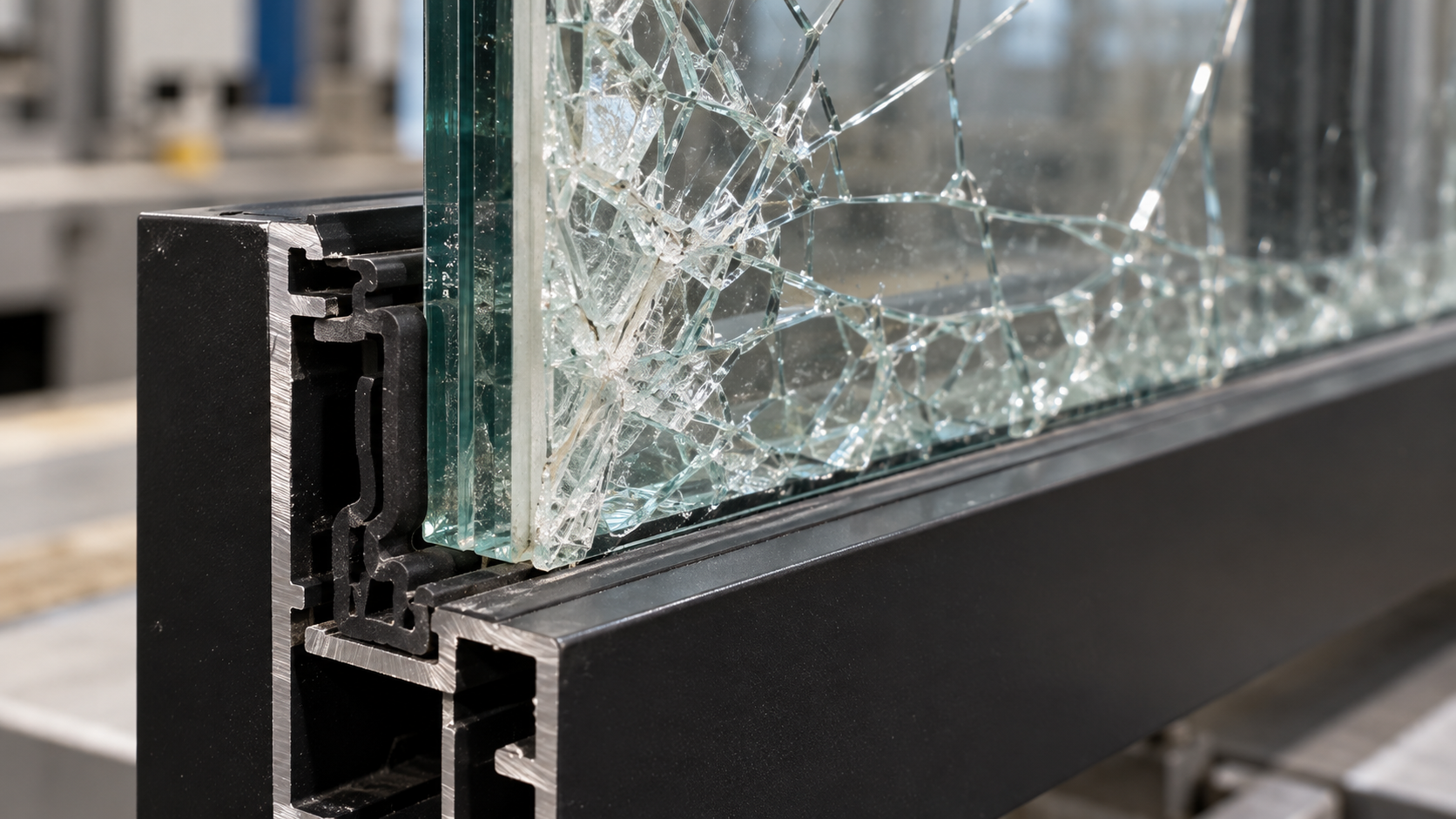
Interlayer type and thickness also affect post-breakage response, but a stronger interlayer cannot rescue inadequate edge support. A substitution from one laminate build-up to another may change thickness, edge compatibility, weight and test coverage. For the safety-glass material comparison, see our guide to laminated versus tempered safety glass in aluminum windows. For impact windows vs laminated windows, retain the exact glass build-up recorded in the assembly evidence unless an approved evaluation permits a change.
Operable hardware determines whether the opening stays closed
Fixed lites eliminate hinges and locks, but casement, awning, sliding and tilt-turn products introduce joints and concentrated loads. Multi-point locks distribute pressure only when keeper fasteners, reinforcement and overlap are adequate. Hinges and friction stays must transfer repeated reversal forces without tearing from the profile. Rollers, interlocks and anti-lift details become critical on sliding units.
Do not assume test coverage transfers freely between operator types. A fixed window report does not prove a casement, and a casement does not prove a sliding door. Dimensions matter as well: greater spans increase deflection, while larger sash area increases force at locks and hinges. A credible impact windows vs laminated windows review maps the proposed opening type and size to the tested or evaluated configuration.
Frame anchorage closes the impact load path
The best glazing package is ineffective if the outer frame separates from the wall. Anchor type, spacing, edge distance, embedment, substrate condition, shim position and sealant joint all need coordination. Concrete, masonry, structural steel and timber do not accept the same fixing schedule. The approved buck or installation detail can be as important as the window itself.
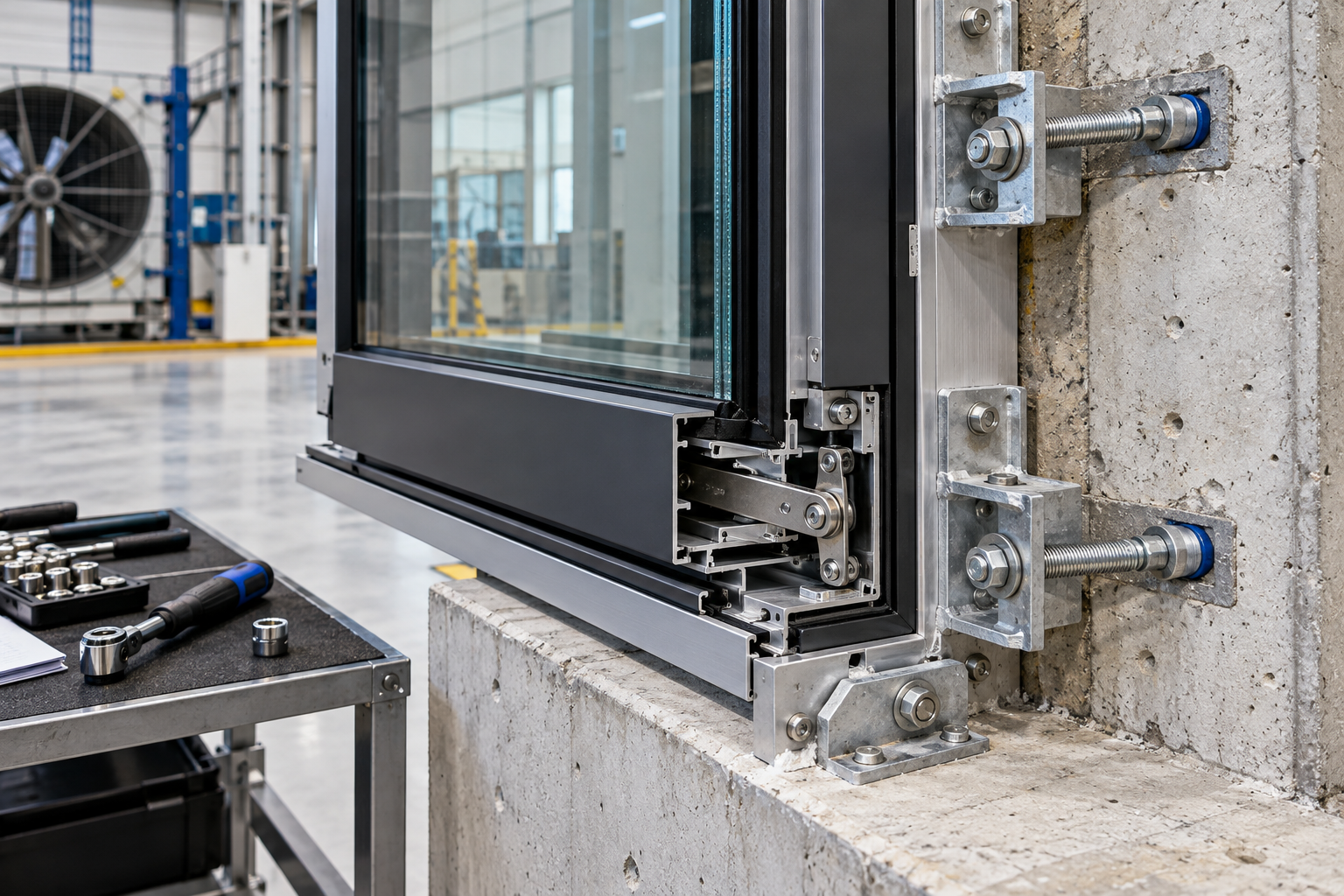
Project drawings should identify structural anchors separately from transport screws and temporary fixings. At site, installers need the correct substrate, drill diameter, embedment and corrosion compatibility. Photos of critical anchors before trims conceal them create a powerful handover record. The distinction in impact windows vs laminated windows becomes especially clear here: laminated glass data says nothing about frame-to-building attachment.
Read the report before accepting the label
The report or approval should state the standard and edition, missile level or category, pressure sequence, maximum specimen dimensions, product type, glass make-up, profile system, reinforcement, hardware and installation. Check which variations are explicitly permitted. Smaller sizes may not always be covered automatically, and changing aspect ratio can relocate critical loads. The specifying authority or product approval rules govern.
Buyers can use our ASTM E1886 and E1996 specimen guide to review the test logic, then compare the proposed assembly with the report line by line. If the evidence says “designed to meet,” treat it as an engineering intent until the appropriate test, certification or approval is supplied. This evidence-first approach makes impact windows vs laminated windows a procurement decision that can survive technical review.
How StarveilBuild controls an impact-window configuration
Our 15,000 m² facility sits in Foshan, Guangdong — the heart of China’s aluminum industry. CNC machining, assembly, QC inspection and export packing are managed in-house; profile extrusion, glass tempering and powder coating are handled by long-term partner facilities within a 30 km radius. For impact windows vs laminated windows, the production file records profile and reinforcement codes, glass build-up, bite, gaskets, bead direction, hardware maps, fastener locations and the proposed anchor interface. Performance claims remain tied to the named report and project requirements. See the factory for yourself — book a live video tour.
A critical buyer checklist for impact windows vs laminated windows
- Confirm the trigger. Record the jurisdiction, windborne-debris requirement, building height and design pressures.
- Name the evidence. Request the complete report, approval or evaluation—not a cropped cover page.
- Match the specimen. Compare operator, dimensions, glass, interlayer, profiles, hardware and reinforcement.
- Trace retention. Verify bite, beads, gaskets, setting blocks and post-breakage support.
- Review the substrate. Coordinate anchor type, spacing, embedment, edge distance and perimeter seal.
- Freeze substitutions. Require written review before changing glass, hardware, fasteners or profiles.
- Inspect production and site work. Retain QC records, labels and concealed-anchor photographs.
Send StarveilBuild the project location, required standard, design pressure, opening schedule and target approval. We can prepare a configuration-gap review showing which parts of the impact windows vs laminated windows evidence are already aligned and which require testing, engineering or authority confirmation.
Impact Windows vs Laminated Windows benchmark and evidence matrix
Use this impact windows vs laminated windows matrix to compare suppliers on the same project inputs. A target is not evidence: the final submittal should connect the offered configuration to a named calculation, test report, approval, supplier document or inspection record.
| Decision field | Project benchmark | StarveilBuild submittal | Acceptance evidence |
|---|---|---|---|
| Governing protocol | Adopted code, ASTM TAS or approval route | Named test sequence and pressure schedule | Current third-party report or approval document |
| Specimen coverage | Product type, maximum size and impact zone | Configuration schedule for frame, glass and hardware | Report pages that match the quoted assembly |
| Design pressure | Positive and negative pressures by opening | Rated size and reinforcement schedule | Engineering check against listed limits |
| Anchorage | Substrate, fastener and edge-distance limits | Project anchor layout | Listed detail or signed calculation |
Benchmark note: values, ratings and pass/fail limits must come from the governing project brief, adopted code and the exact system build-up. Do not copy catalogue values across frame sizes, glass make-ups, hardware sets or installation conditions.
Evidence boundary for U.S. work
Selected configurations can be supported through third-party partner documentation for the applicable ASTM test route and, where the exact assembly is listed, relevant Florida or Miami-Dade approval documentation. Acceptance is configuration-specific: verify the document holder, approval or report number, product type, maximum size, glass, hardware, anchors, substrate and installation limits. StarveilBuild does not describe every product or the factory itself as universally certified.
Related engineering guides and authority sources
Continue the system review with our forced-entry-resistant aluminum window load-path guide, high-rise safety window specification guide and safety-glass selection comparison.
- ASTM E1886 impact-and-cyclic-pressure test method
- ASTM E1996 windborne-debris performance specification
- Miami-Dade Product Control approval resources
How general contractors and code consultants should qualify suppliers for impact windows vs laminated windows
A useful supplier answer should resolve the project type, jurisdiction, required performance, custom configuration and supply terms in one response. Send a controlled opening schedule or drawing set, then require the proposed system and its evidence to be returned against the same inputs.
Multi-constraint supplier qualification matrix
| Buyer constraint | What the supplier should state | Evidence to request |
|---|---|---|
| Hazard and use | Fall, impact, intrusion or post-breakage requirement for the exact opening | Project safety brief and adopted requirement |
| Complete assembly | Frame, glass retention, interlayer, hardware, reinforcement and anchors | Applicable assembly test, approval or engineering assessment |
| Size and installation | Quoted dimensions, substrate and fixing condition inside evidence limits | Scope comparison matrix and approved detail |
| Production traceability | Safety-critical parts frozen in drawings and BOM | Incoming, assembly and final inspection records |
Through cooperation with certification partners, StarveilBuild has obtained certification coverage for selected U.S.-market product configurations. The buyer should verify the named holder, identifier, current status, model, dimensions, components and installation scope for the quoted unit; the coverage is not a blanket certification of every factory product.
Frequently asked questions
What should general contractors and code consultants request when sourcing impact windows vs laminated windows?
Request project safety brief and adopted requirement; applicable assembly test, approval or engineering assessment; scope comparison matrix and approved detail; incoming, assembly and final inspection records. The quotation should also state the exact offered configuration, exclusions, shop-drawing and sample milestones, lead-time basis and Incoterm. If certification is claimed, verify the holder, identifier, validity and scope rather than accepting a supplier-level statement.
What is the most important difference in impact windows vs laminated windows?
Laminated glass identifies a glazing material; an impact-rated window identifies a complete assembly evaluated against a defined protocol. The assembly evidence must cover the glass, retention, frame, sash, hardware, anchors and installation.
Does laminated glass make a window hurricane impact rated?
No. It may provide fragment retention, but the complete system still needs the required assembly-level evidence. Beads, sash joints, locks and frame anchors can fail even when the laminate remains together.
Why does cyclic pressure follow the missile impact?
Wind loading continues after debris strikes. Positive and negative pressure cycles assess whether the damaged assembly can remain unbreached through load reversals representative of a severe windstorm protocol.
Can a tested fixed impact window prove a casement configuration?
Not automatically. Operable products introduce hinges, locks and joints that change the load path. The proposed type and size must fall within the report, approval or accepted engineering scope.
Can the installer change anchors on an impact-rated window?
Only after documented review under the applicable approval and project criteria. Anchor material, diameter, spacing, embedment, edge distance and substrate are performance-critical parts of the installation.
What should importers request before ordering impact windows?
Request the full test or approval record, configuration schedule, glass make-up, hardware map, anchor detail, labeling rules and substitution limits. Then match every field to the purchase order and shop drawings.
Conclusion: buy the verified assembly
The safest conclusion on impact windows vs laminated windows is simple: a material feature is not a system rating. Start with the governing hazard and standard, then follow the load from the cracked pane through the frame and into the wall. When every interface matches documented evidence, the claim becomes defensible; when one interface changes without review, the label may no longer describe the delivered window.