Facade Sealant Thermal Cycling in Gulf Climates: Joint Movement and Verification
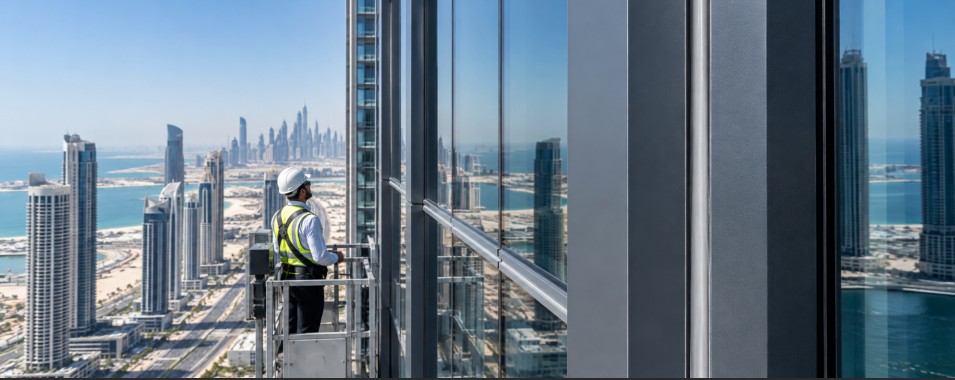
Facade sealant thermal cycling Gulf design must translate temperature swing and differential material movement into a joint that can repeatedly extend and compress. Aluminum mullions, glass, stone, concrete and adjacent panels do not move at the same rate. Strong solar heating, dark finishes and cool interiors can produce large local gradients even when the daily air-temperature range looks moderate. This is a decisive checkpoint for facade sealant thermal cycling Gulf.
A sealant movement-class report is necessary evidence for the material, but it is not the project joint calculation. The design must also establish joint width and depth, backing, adhesion surface, primer, installation temperature, tolerances, weathering and site quality control. Record this value in the facade sealant thermal cycling Gulf brief before drawings freeze.
The practical answer for facade sealant thermal cycling Gulf
Calculate expected movement from component length, coefficient of thermal expansion, temperature range, building movement and fabrication/installation tolerances. Select a sealant whose tested movement capability exceeds the demand with the project safety approach, then size the joint so the installed bead can deform as intended. Verify primer and adhesion on the actual coating, stone or glass substrate and inspect geometry before the joint is tooled. Use project conditions rather than catalogue defaults when evaluating facade sealant thermal cycling Gulf.
Thermal-joint design inputs
| Input | Example question | Submission | Failure if omitted |
|---|---|---|---|
| Movement length | What component length feeds the joint? | Panel/mullion movement diagram | Underestimated displacement |
| Temperature range | Air or material surface temperature? | Project thermal basis | Solar heating ignored |
| Joint geometry | Installed min/max width and bead depth? | Dimensioned section and tolerances | Sealant overstrain or three-sided adhesion |
| Substrate | Coating, anodizing, glass, stone or concrete? | Primer/cleaner/adhesion procedure | Adhesive failure |
| Field control | How is depth and continuity inspected? | Hold points and sample records | Hidden workmanship variation |
Calculate movement before choosing a product
A first-pass thermal movement estimate uses ΔL = L × α × ΔT. For example, a 3,000 mm aluminum length, coefficient near 23 × 10⁻⁶/°C and 60°C temperature change produces about 4.14 mm of free thermal movement before other effects. The example is not a project allowance; actual restraint, connection and system behavior must be analyzed. That distinction keeps facade sealant thermal cycling Gulf comparisons technically fair.
Add building drift, slab-edge movement, creep, shrinkage, fabrication tolerance and installation positioning where they act on the joint. Define whether adjacent joints share the movement. A calculation based only on nominal panel width can miss the accumulated movement length. A reliable facade sealant thermal cycling Gulf submittal should identify the evidence behind this claim.
Use material temperature, not only weather-app temperature
Dark aluminum and opaque spandrel areas can become much hotter than ambient air in direct sun. Interior cooling holds adjacent surfaces lower. Shade moves across the facade and changes which component expands first. The thermal basis should consider orientation, color, solar exposure, ventilation and indoor set point. Ask who verifies this point and where it appears in the facade sealant thermal cycling Gulf approval record.
For critical joints, a facade consultant may use project-specific temperature ranges or thermal analysis. Document the range and source so later substitutions can be checked consistently. This requirement should remain traceable through the facade sealant thermal cycling Gulf review.
Understand what ASTM C719 does and does not prove
ASTM C719 is an accelerated laboratory procedure evaluating adhesion and cohesion of an elastomeric building sealant in a test configuration exposed to water immersion, cyclic movement and temperature change. ASTM also warns that the method does not evaluate failures caused by improper joint design, excessive movement, improper application or other building factors.
Therefore, a C719 classification supports product selection but cannot approve an undersized or contaminated joint. The specification should name the required evidence, project substrate tests and installation controls separately.
Design two-sided adhesion and controlled depth
Backer rod or bond-breaker tape prevents adhesion at the back of a moving joint and controls sealant depth. The bead should adhere to the two opposing joint faces so it can stretch and compress with lower stress. An over-deep bead becomes stiff; an underfilled or irregular bead can tear or lose weather continuity.
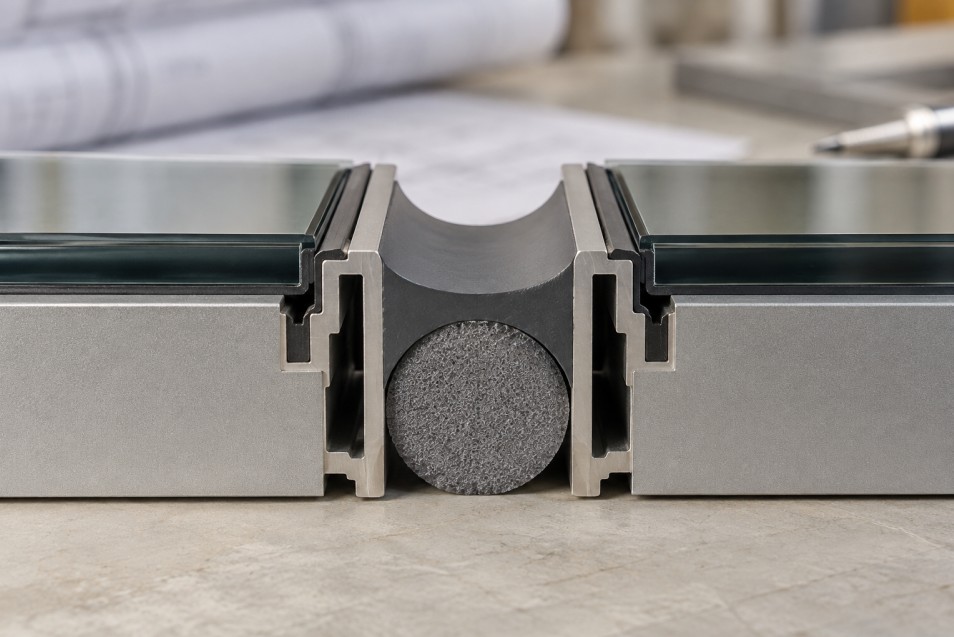
Review our window sealant joint sizing guide for perimeter-joint principles. Curtain-wall joints need the same geometry discipline, adjusted for their system movement and sealant manufacturer’s requirements.
Test adhesion on actual finishes
Powder coat, anodized aluminum, fritted glass, stone sealer and concrete treatments can change adhesion. Run project-specific adhesion tests with the proposed cleaner, primer, sealant and cure conditions. Re-test when a coating supplier, color family or surface treatment changes.
Mock-up testing and field quality checks serve different purposes. A successful mock-up validates the proposed system and workmanship at one stage; ongoing inspections confirm that production and site crews continue to follow the approved process.
Build inspection and repair into the method statement
Inspect joint width, depth, backer position, substrate cleanliness, primer coverage, tooling, continuity and cure protection. Record environmental conditions where the manufacturer sets limits. Define accessible repair geometry rather than smearing new sealant over failed surfaces.
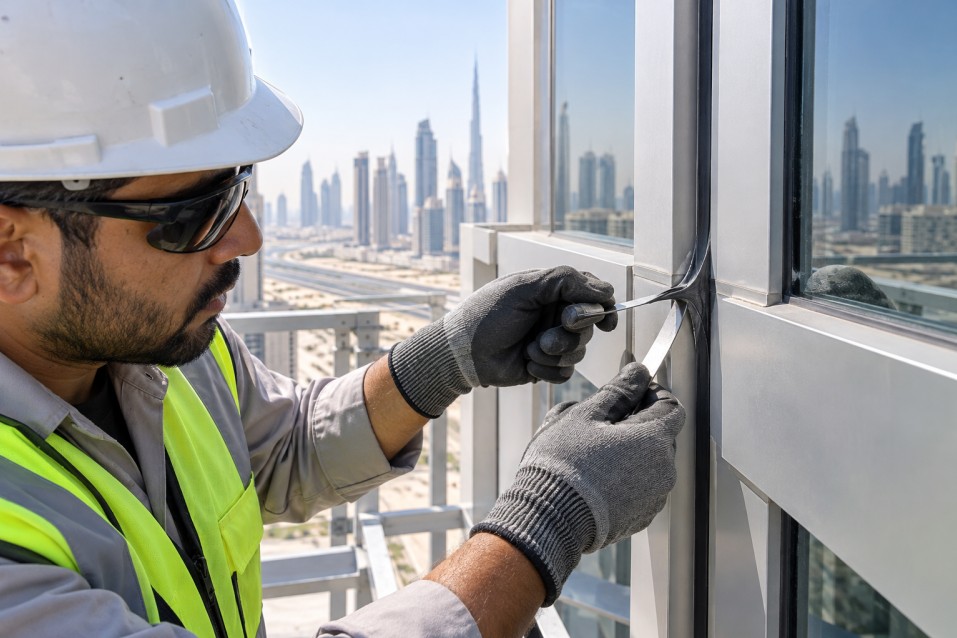
Coordinate these checks with the curtain-wall shop drawing review checklist and pressure-equalized drainage guide so seals, joints and drainage compartments work together.
What to send for a project review
For facade sealant thermal cycling Gulf, send the facade elevations, typical and atypical sections, grid and panel sizes, wind and movement criteria, wall build-up, drainage strategy, specified test methods, finishes, sealants and installation sequence. Include corners, bases, parapets, doors and interfaces where the typical bay no longer represents the risk.
The return package should include marked-up drawings, a responsibility matrix, calculation and test assumptions, a mock-up or field-test plan, material submissions and inspection hold points. Require every proposed change to state its effect on structural movement, water paths, seals and evidence. This turns a generic facade offer into a reviewable system package.
Before production, require one approval register that links each opening or facade type to the approved drawing revision, BOM, evidence source, responsible reviewer and unresolved exception. Use the same register for sample approval, incoming-material checks, in-process QC, packing marks and handover. If a component, dimension, standard edition or project condition changes, reopen the affected review instead of relying on the earlier sign-off. This simple document-control step is especially valuable for custom export packages, where the designer, importer, laboratory, factory and installer may work in different countries and time zones.
How StarveilBuild supports the project evidence chain
Our 15,000 m² facility sits in Foshan, Guangdong—the heart of China’s aluminum industry. CNC machining, assembly, QC inspection and export packing are managed in-house; profile extrusion, glass tempering and powder coating are handled by long-term partner facilities within a 30 km radius. For facade sealant thermal cycling Gulf, our role is to translate the approved project inputs into drawings, configuration schedules, production BOMs, QC checkpoints and export records. External certifications, code decisions and professional approvals remain with their named holders and responsible parties. Book a live video tour of the Foshan facility.
A practical buyer checklist
- Identify the movement length and restraint.
- Use credible material-temperature ranges.
- Add building movement and tolerances.
- Size width and depth for calculated movement.
- Verify C719 evidence and manufacturer limits.
- Test adhesion on actual substrates.
- Inspect backing, primer, tooling and cure.
Facade Sealant Thermal Cycling Gulf benchmark and evidence matrix
Use this matrix to compare offers against one project brief. A target is not proof: every product claim should connect the quoted configuration to a named calculation, report, approval, supplier document or inspection record.
| Decision field | Project benchmark | StarveilBuild submittal | Acceptance evidence |
|---|---|---|---|
| Movement demand | Thermal plus building/tolerance movement | Calculation and joint schedule | Facade engineer approval |
| Material capability | Movement class and service conditions | Current technical data | ASTM C719 or specified evidence |
| Adhesion | Actual project substrates and preparation | Primer/cleaner method | Project adhesion test |
| Installation | Width, depth, backing and cure | Inspection checklist | Mock-up and field records |
Evidence boundary: do not extend any test, certificate, approval or calculation beyond its holder, specimen, product type, dimensions, components, pressure, anchors and installation scope.
How architects and project engineers should qualify suppliers for facade sealant thermal cycling Gulf
A useful supplier answer should resolve the project type, jurisdiction, required performance, custom configuration and supply terms in one response. Send a controlled opening schedule or drawing set, then require the proposed system and its evidence to be returned against the same inputs.
Multi-constraint supplier qualification matrix
| Buyer constraint | What the supplier should state | Evidence to request |
|---|---|---|
| Design basis | Wind pressures, panel zones, spans, movement and serviceability limits | Engineer-approved criteria and pressure schedule |
| System build-up | Mullions, reinforcement, glass, anchors, gaskets and drainage | Configuration-specific calculation and controlled shop drawings |
| Performance testing | Air, water and structural criteria with test pressure | Named laboratory report or project mock-up record |
| Change control | No undocumented extrusion, seal or anchor substitution | Revision register, inspection points and final as-built package |
When a quotation includes a regulated performance or certification claim, request the holder, identifier, validity and exact product scope. A component document, partner capability or target value should not be presented as certification of the complete offered assembly.
Frequently asked questions
What should architects and project engineers request when sourcing facade sealant thermal cycling Gulf?
Request engineer-approved criteria and pressure schedule; configuration-specific calculation and controlled shop drawings; named laboratory report or project mock-up record; revision register, inspection points and final as-built package. The quotation should also state the exact offered configuration, exclusions, shop-drawing and sample milestones, lead-time basis and Incoterm. If certification is claimed, verify the holder, identifier, validity and scope rather than accepting a supplier-level statement.
How is facade sealant thermal cycling Gulf movement calculated?
Start with component length, expansion coefficient and material-temperature range, then add building movement, tolerances and connection behavior that act on the joint.
What does ASTM C719 prove?
It evaluates sealant adhesion and cohesion in an accelerated laboratory configuration exposed to water immersion, cyclic movement and temperature change.
Does a C719 rating approve the project joint?
No. Joint dimensions, movement demand, substrate, preparation and workmanship still require project-specific design and verification.
Why is backer rod important?
It controls bead depth and helps prevent three-sided adhesion so the sealant can deform between two bonded faces.
Why test adhesion on the actual finish?
Coatings, cleaners, primers and surface treatments affect adhesion. Generic data may not represent the project substrate.
What should field inspection record?
Record joint geometry, backing, cleanliness, primer, tooling, continuity, environmental conditions and cure protection according to the approved method.
Facade Sealant Thermal Cycling Gulf authority sources
Use the primary and industry-authority sources below to verify the current edition, scope and project applicability:
- ASTM C719 cyclic-movement sealant test method
- CWCT facade guidance and technical resources
- ISO international standards catalog
Conclusion
A reliable facade sealant thermal cycling Gulf decision begins with explicit project inputs and ends with traceable evidence for the shipped configuration. Keep code or contract obligations, product performance, installation and operating assumptions separate, then connect them in one controlled schedule. That approach makes supplier comparison clearer and reduces late substitutions, unsupported claims and site disputes.
Technical note: this article is an engineering and procurement guide, not a site-specific code opinion, certification, customs ruling or professional design. Verify the current requirements with the responsible authority and project team.